

Welcome to the Formula One Financial World Championship, a competition comprising nine of the fastest racing teams on Earth but with a twist. The team who tops the standings will not have the fastest car, nor the quickest driver, neither the most pushy team boss – this is a championship to determine the most financially sound F1 team.
You may assume the most financially sound team would be the reigning world champions, they are awarded the most prize money of course however this may not be the case (yes, that means there is an F1 championship running in 2023 Red Bull will not win).
The championship consists of the teams’ financial accounts undergoing serious scrutiny with four accounting ratios then calculated to determine an order. The most recent published accounts have been used which in most cases is 2021 with the exception of Aston Martin who only have 2019 (when they were Racing Point). Additionally. Alfa Romeo have been omitted due to having no published accounts and Ferrari’s are for the whole company (not just the F1 outfit).
Now the rules are laid out, let’s get into the first two rounds (the second pair of ratios and full results will be in a second instalment next week).
Operating Profit Margin
One of the main objectives for any business is to turn a profit and ensure consistent, improving profitability and an F1 team is no different. Therefore as the aim of these teams is to make money it seems a logical place to start the championship from.
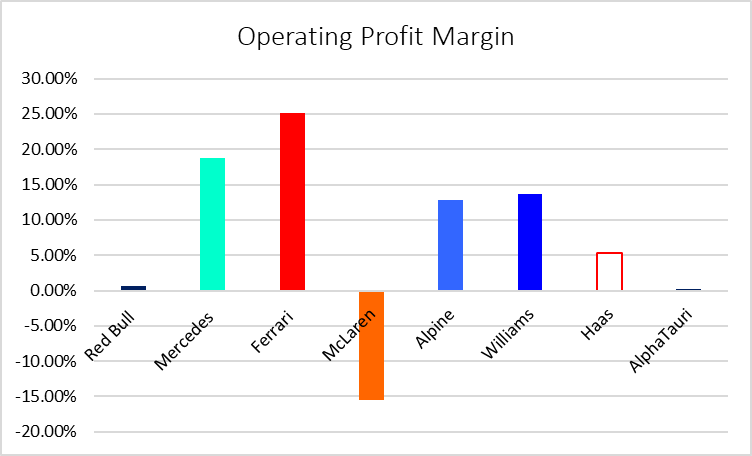
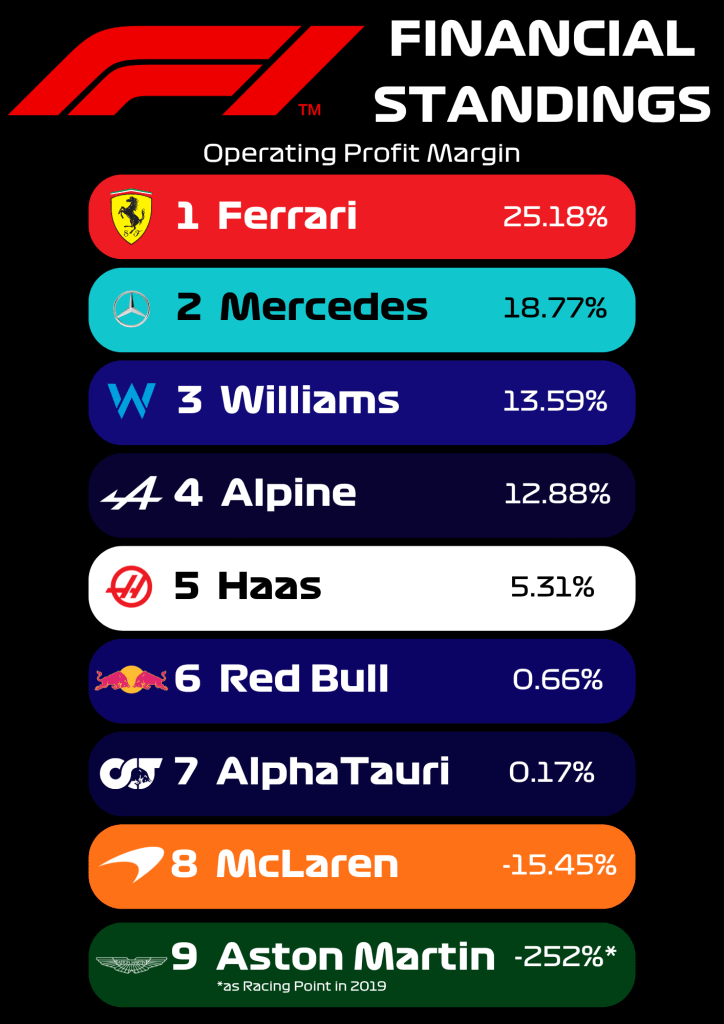
Now the obvious winner in this is Ferrari with an impressive operating profit margin of 25.18% however Mercedes is not too far off at 18.77% especially as for the purpose of this they are the leading solely F1 outfit. Williams and Alpine also have decent profit margins proving that even teams in the midfield or towards the back can also be sustainable businesses.
Aston Martin (Racing Point) are were in a seriously concerning position in 2019 although I hope things have improved under the custody of businessman Lawrence Stroll. The more pressing concern at this point is McLaren who have also reported a loss but with no change to their situation, hopefully their new-found form on the track is also mirrored in their finances.
Current Ratio
It’s all well and good that most of the teams are turning a profit but that doesn’t mean a business is perfect. A business’ liquidity (ability to turn assets into cash and cover day-to-day costs and debts) is another important factor to consider when assessing financial performance.

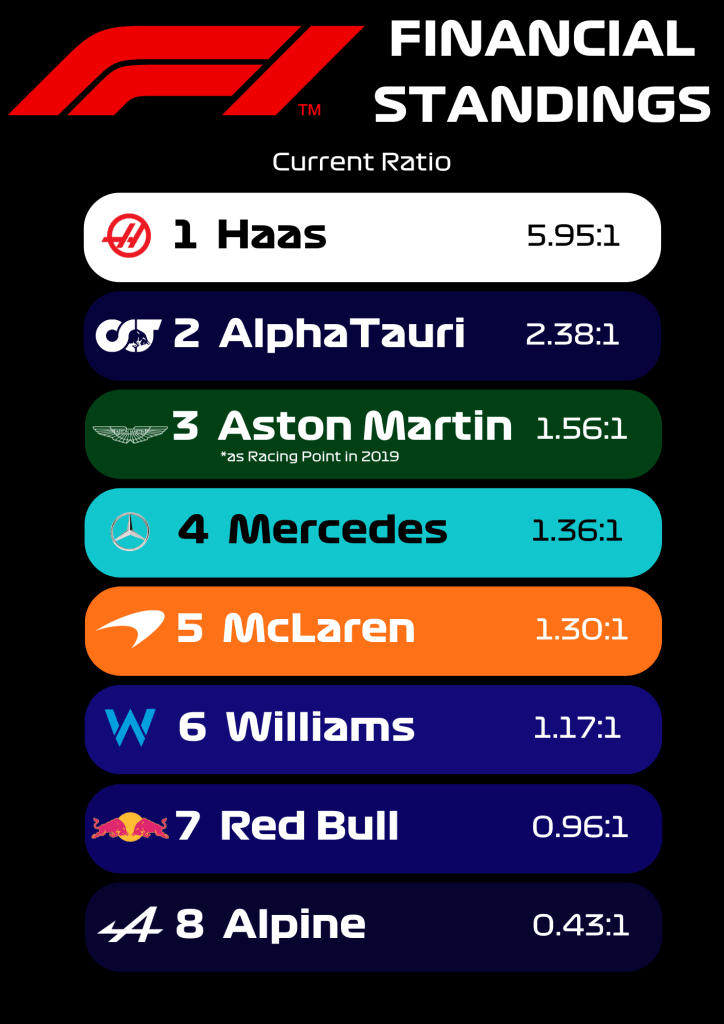
The clear leader in this is Haas with a current ratio of 5.95:1 however that may not be as good as it appears: Haas may be holding too much in cash (therefore not maximising the return on their capital) or holding a lot of stock. AlphaTauri, Aston Martin, Mercedes and McLaren all have reasonable levels of liquidity allowing them to quite comfortably cover any current liabilities while also being able to use their resources efficiently.
The causes for concern are the teams with a current ratio less than 1:1 (Red Bull and Alpine). This means that they have more current liabilities than they do current assets (including stock) which could indicate a cash flow problem within the businesses and an inability to pay suppliers on time (especially Alpine).
Ferrari are not in this round as I could not find any information as to the value of their current liabilities.
So far, none of the teams are showing to be in a complete mess although some (Alpine and Aston Martin especially) have some serious areas to improve. Although, we have effectively shown that you can have a financially sound (so far) Formula One team without being at the front of the field.
Which teams do you think will be near the top? Which teams will show themselves to be in an even worse position in the second round?
Do comment your thoughts below.


 Money and More
Leave a comment