
The sorry state of local newspapers.

Photo by brotiN biswaS on Pexels.com

When was the last time you bought a local newspaper? Checked their Facebook page? Even acknowledged that local media still exists in this modern world? Sadly, people are engaging in the aforementioned acts far too infrequently leading to the sorry the state we have now.

From the pillars of the community, local newspapers have been reduced to all but a pamphlet often not even being written in the town they purport to represent as they failed to adequately adapt to the digital revolution and people’s newfound reticence to print journalism.

With ever increasing costs of production, the local newspapers are almost at breaking point and the larger businesses that run them are in a state that is anything but healthy as you will soon see.

Firstly to National World/JPI Media which has been through more reincarnations than most religious figures none of which have yielded particularly positive results.

Due to their many, many different corporate structures, comprehensive and coherent accounts are hard to come by but over the past two years their performance has been comparatively decent (which says a lot). In 2020, they made a 33% net loss but in 2021 they made £5 million – profit! Such a rarity in the world of local news.

As a result of their reformation as National World, the almost laughable 2020 gearing ratio of 3623% has been reduced to a legitimately respectable 14% – maybe shutting up shop and restarting half a dozen times is the secret to success in this newspaper game.

Next onto Newsquest who also have very scant financial information but within in that is some relatively impressive (by the dismal standards set by their competitors) as they have completely recovered from the Coronavirus pandemic profitability-wise and have the most lovely liquid capital ratio of 3.51:1.

A more mediocre set of accounts (but in sufficient detail) is from Reach plc who probably should not be included in this due them being a behemoth with a few national titles in their roster which are probably propping things up to an extent.

Over the past 4 years they have averaged a 3.15% net profit margin which although not massively impressive does include a £27 million loss as a result of the Coronavirus pandemic. Liquidity may be an issue for them in the future as their liquid capital ratio is teetering around the 1:1 mark (0.4:1 in 2021).

Finally it is the pretty dire case that is Iliffe Media who despite recent acquisition sprees are not doing amazingly well as the only company in my analysis who has recorded a negative net assets figure in two consecutive years – reaching the dizzying lows of -£2 million in 2022.
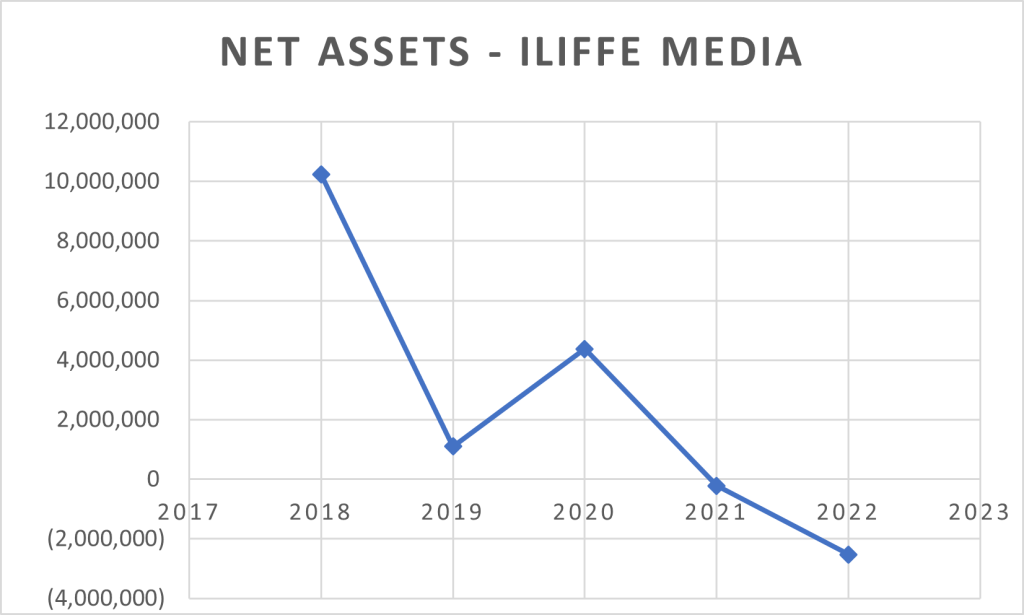
Profitability is also an issue for the firm based in Cambridgeshire as in the past five years they have failed to turn a profit once recording a £10 million loss in 2019 alone. Debt also seems to be an issue for the beleaguered business as in four of the past five years the gearing ratio has been greater than 100% by at least one metric.

In conclusion, the world of local newspapers is not in a particularly positive state with all the businesses involved attempting to diversify down various digital alleyways but to very minimal success.

3 responses to “The sorry state of local newspapers.”

  1. David Sperry aka BigHemi Avatar
    David Sperry aka BigHemi

    Great article. It seems that no industry will escape your scrutiny. I see a Business Professor or Investigative Journalist as your path to success.

    From what you describe, the UK newspaper industry is similar to the US. We have National newspapers like the New York Times, and then cities of a decent size have their daily papers. Large towns might have a weekly paper (probably published by a nearby daily paper), and then there are the Township pamphlets that report the schedule for the high school marching band rehearsals.

    I live in Central Pennsylvania (PA) near a small city, and we are lucky enough to have one of the best seven days per week papers in all of PA. It was founded 150 years ago and is still owned by the same family. It has survived all these years by staying relevant and modernizing and reorganizing when necessary.

    But it’s good management that allowed the paper to thrive. They have found the right balance between local, national and world news, and the articles and editorial content cover the whole spectrum of political points of view.

    But even the best run newspapers are faced with rising costs that can’t be passed on to the reader or covered by additional advertising. The costs of labour, materials and distribution never stop rising, so the owners have taken innovative steps to secure the newspaper’s legacy.

    The newspaper will be merging with a major independent TV station in the State capital, not far from here. This complex merger of two not-for-profit organizations will allow the family to maintain editorial control over the newspaper, with operational expenses coming from the merged company. It’s a very unusual type of merger, only allowed when the merging parties have historic or artistic significance.

    I’m not familiar with the term Gearing Ratio. Could you explain it please.

    I believe you have been very busy writing exams and helping other students. When you have time, please drop another of your interesting automotive posts on Race Director. Many thanks.

    Like

    1. Thanks, at the moment I’d like to be a business studies teacher but we shall see. Newspapers are more something close to home and I did the research not fully with the intention of wrong about it.

      We don’t have the miniature pamphlets (unless you count the ill-fated parish magazines that nobody read nor advertised in) but pretty much every town has a newspaper, even some very small ones have two!

      That sounds a really interesting model that we haven’t really replicated in the UK, newspapers just get bought and sold between the groups I mentioned and everything just gets cut down (my dad does the sports coverage for four different towns, none of which he lives in!).

      The gearing ratio is a calculation as to how much debt a business has compared to how much it’s worth (equity). There are many ways to calculate it (I have a textbook that gives you six) and it’s been a source of debate my times but I tend to use long term liabilities/capital employed and long term liabilities/net assets which yield slightly different results but are both useful (although the latter sometimes gives you a random number).

      Exams start this week and I have been doing a few other interesting things but if I get time then I’ll be writing about F1.

      Like

      1. David Sperry aka BigHeni Avatar
        David Sperry aka BigHeni

        Thanks for the definition of Gearing Ratio. I’m not sure which of the six I favour. Kidding of course!

        Liked by 1 person

Leave a comment