
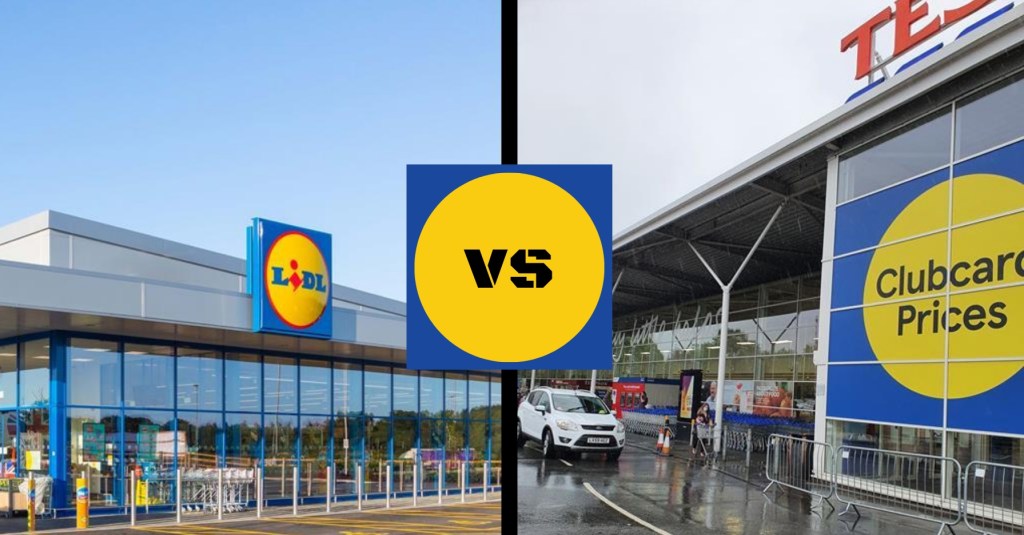
Two of Britain’s largest supermarkets are at war and legal minds across the land have been debating these serious questions: can you own a combination of colours and shapes? Does using similar visual cues constitute copyright infringement? Do supermarkets seem to be obsessed with taking each other to court these days over the minute details?
Lidl decided to take Tesco to court over their use of a blue square and yellow circle to promote their ‘Clubcard Prices’ campaign with the German discounted citing that Tesco were ‘passing off’ as associated with Lidl and were capitalising on the association between Lidl’s corporate colours and low prices.
Lidl asked Tesco to stop using the colours in the same way in their promotions however Britain’s largest supermarket declined leaving the discount retailer to take them to court over their use of primary colours and basic shapes.
In this instance, the High Court judge ruled in favour of Lidl as Tesco had engaged in “copying with a view to enhancing the value perception of Tesco’s own Clubcard Prices offering by adopting a getup, in the form of a blue background and yellow circle, which already had a proven association with a strong value proposition (ie the Lidl Logo) in the minds of consumers”.
However in November of last year a court ruled in favour of Tesco that Lidl had attempted to trademark their shapes and design in ‘bad faith’.
Yet this ruling means that Tesco will now have to discuss an amicable solution to this with Lidl which will most likely mean that the supermarket will have to stop promoting their Clubcard Prices offer in this way.
Any form of legal fracas between businesses will always pique my interest (see Colin vs Cuthbert) however I fail to see the logical reasoning behind this one. I have seen that Clubcard promotion thousands of times and have not once made the link to the German competitor nor I doubt has anyone else.
The link between that colour scheme and value may be ingrained in our subconscious although to my mind the same could be said for Lidl’s copycat products which draw on the colours of the major brands to convey familiarity and quality to the consumer – how is Tesco’s (in my eyes innocuous) yellow circle any different to that? Does this mean that every time a company uses the same colours in a similar shape we need a court case?
A spokesperson for Lidl’s British business said: “Over the last three years, Tesco has been using its Clubcard logo to deceive many customers into believing that Tesco was price matching against Lidl or was able to offer the same great value as us.
“We asked Tesco to change their Clubcard logo, but they refused, making it necessary to bring this case. Having seen the evidence, the court has now ruled that Tesco’s Clubcard logo was copied from Lidl’s logo, and it infringes Lidl’s trademark rights and copyright.
“This infringement allowed Tesco to take unfair advantage of our longstanding reputation for great value, misleading their customers at a time when they should have been supporting them. We are pleased that the court has agreed with us and that it will now order Tesco to stop using the Clubcard logo.”
A Tesco spokesperson said. “We are surprised and disappointed by the decision today in relation to the claim brought by Lidl against our Clubcard Prices logo. Clubcard Prices has always been about offering great value to our Clubcard customers, across thousands of products, as part of our commitment to keeping the cost of the weekly shop as affordable as possible. Nothing in today’s decision changes that.
“This claim brought by Lidl was just about the colour and shape of the Clubcard Prices logo. The judge’s ruling concluded that there was no deliberate intent on Tesco’s part to copy Lidl’s trademark.”
Do comment your thoughts below.

 Money and More
Leave a comment