

5000% APR, misleading advertising, lax credit checks – these were the problems which led to the downfall of the payday loan industry, an industry which took the phrase “A business’ job to make money” to extremes earning the nickname ‘the crack cocaine of debt’.
The payday loan industry was battered to a point where it barely exists today due to harsh regulations and controls that stifled their heavily profitable business model.
Billions of pounds had to be paid in compensation to borrowers who the payday lenders had misled or lent money to when it was unadvisable to do so. This pretty sudden outpouring of money from the companies led to many (most notably Wonga) going bankrupt.
Payday loans burst onto the scene in the 1990s, touting their products as a solution to the problem nobody had of short-term borrowing in small amounts to cover the borrower to the next ‘payday’ but with a hefty cost attached.
These companies poured billions into marketing to convince consumers that there products should be a part of their financial lives with financial expert Martin Lewis saying, “Some even told anecdotes of drunk people, coming home, watching gambling on TV, seeing Wonga’s ads then pushing the button for instant cash at 5,000% APR to bet with.” – clearly not a morally sound offering.
Following the 2008 financial crisis, the payday loan companies saw an upturn in demand as cash-strapped individuals sought extra borrowing to cover their lack of money to spend even if they couldn’t afford any more debt, further bolstering these rather unethical businesses.
In 2015, the Financial Conduct Authority (FCA) came down hard on the unscrupulous tactics of the payday loan companies with harsher regulation on interest rates, how much borrowers could be charged and checking customers could actually afford the loan (something that was rarely checked).
The FCA’s crackdown subsequently opened the floodgates for irate customers to reclaim the interest and extortionate fees from these financial products they were missold and shouldn’t have had in the first place.
Millions of pounds was paid to the borrowers who were missold loans they were unable to pay back and that spelt the beginning of the end for the payday loan industry. Lenders including Wonga, Wageday Advance, the Money Shop, Payday UK, Payday Express, QuickQuid, and Pounds to Pocket all collapsed into administration as a result of the deluge of claims.
One of the most notable failures was Wonga – famed for its slightly creepy TV adverts with puppet grandparents and being the market leader with some of the highest fees and worst tactics.
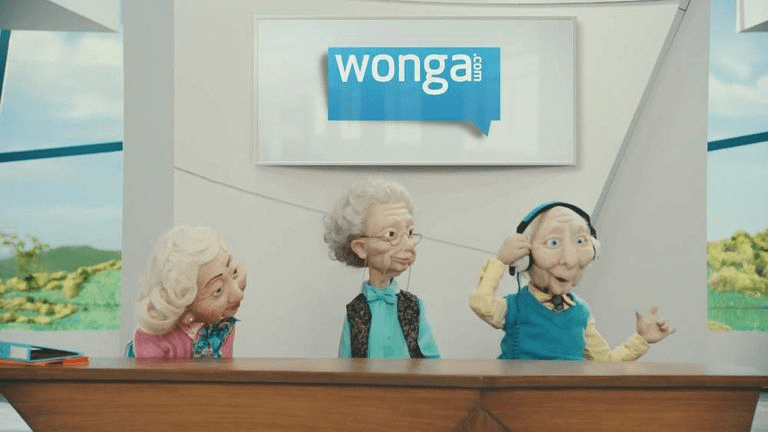
Wonga fell into administration in 2018 after losing £66.5 million in its final year of trading under the weight of a £2.6 million fine from the FCA and thousands of compensation claims which each cost the company £550.
Unlike most when most companies go into administration, there was a sigh of relief when Wonga collapsed as it meant the highly unethical industry was finally entering weakening with Martin Lewis stating, “Normally when firms go bust, the fear is diminished competition. Not here. Wonga’s payday loans were the crack cocaine of debt – unneeded, unwanted, unhelpful, destructive and addictive. Its behaviour was immoral, from using pretend lawyers to threaten the vulnerable, to pumping its ads out on children’s TV.”
Despite the toxic flaws evident in the payday loan industry, companies touting these financial products still exist (albeit stifled by increased regulation). In some cases, debt is useful and needed but with payday loans, they are a financial product you would never want – not only due to of the high costs but also because the mere mention of one on your credit file could spell the end of your mortgage application.
Payday loans really are the scourge of the borrowing market but they aren’t the only instance where a financial product spelt disaster for millions: next week I’ll be covering the PPI scandal.
Do comment your thoughts below.


 Money and More
Leave a comment