
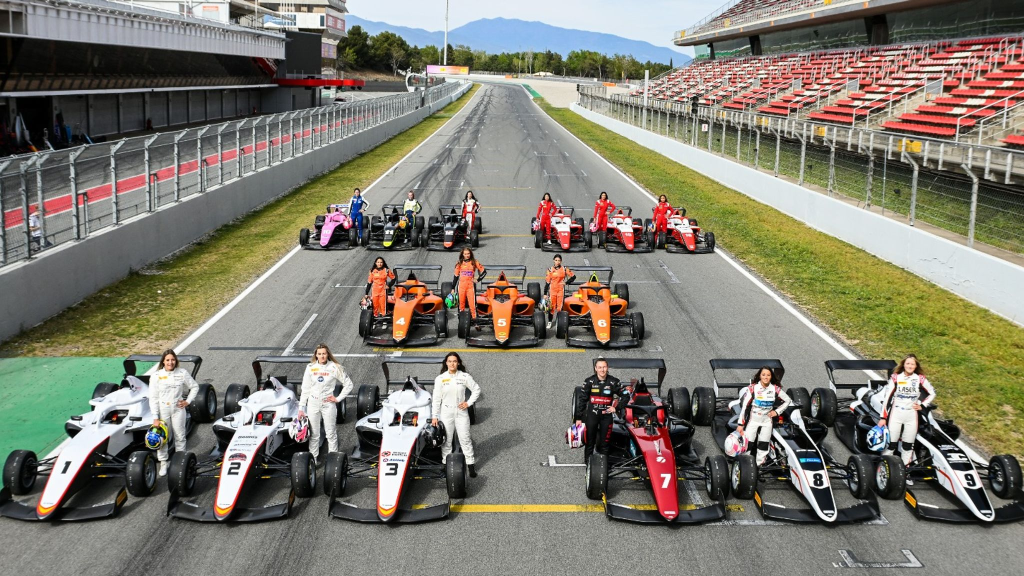
The all-female racing series’ inaugural campaign has reached its conclusion with Marta García becoming F1 Academy’s first champion.
However, since the chequered flag fell after Sunday’s race, questions have been raised as to whether F1 Academy is set to achieve its objective of promoting women in motorsport ultimately leading to a woman in Formula One.
Over 21 races and seven rounds some of the leading lights in female motorsport battled it out trying to prove that among them is the next hot talent that could make it to the pinnacle of motorsport however I’m not sure if this was really achieved.
Firstly, the series is around the same level as Formula 4 and is broadly a step backwards from W Series (where some of the girls previously raced) meaning that some of the best female talents weren’t on the grid such as Jamie Chadwick and Jessica Hawkins with the former not even allowed to compete due to the championship’s age restrictions.
This means that we don’t really know if the winner is the best young female talent as there are a lot of talented drivers who weren’t on the grid.
Marta García is continuing her motorsport career in FRECA next season with a seat sponsored by Alpine so it will be interesting to see how she gets on in a different field, hopefully she is very successful!
Another issue is the (lack of) visibility the series had, for 6/7 rounds the only way fans could ‘see’ F1 Academy was through a live timing page. From the United States round onwards, F1 Academy will be broadcast and be a Formula One support event but I’d imagine if I asked 100 motorsport fans few would have any idea what’s been going on in F1 Academy.
F1 Academy has also come under fire from viewers for having somewhat lax driving standards. Track limits are pretty much non-existent in F1 Academy (because some drivers are inexperienced in their first season of cars) which some Formula One fans coming to the series were rather bemused by as they thought it reduced the gravitas of the championship.
On the other hand, F1 Academy has some key advantages as a feeder series: the championship is partly funded by Formula One meaning it is less likely to go the same way as W Series which was horrendously mismanaged.
In addition, next season, each F1 team will have a car in the series backing a driver giving more funding security and the chance for the women to work with a Formula One team to advance their career and professionalism.
On the subject of funding, it has been announced today (October 26) that the contribution by the driver has been reduced from £150,000 to £100,000 making it more affordable for racers who are more likely to be able to cover the cost with sponsorship (if they don’t have support from a Formula One team). Although W Series was free to enter, this is a more sustainable way forward.
The final benefit F1 Academy now has is ties to other feeder series. Teams in FRECA will now be allowed an additional, fourth car if they take a driver who finished 1-3 in F1 Academy to incentivise other junior teams to take on female talent.
In conclusion, I think F1 Academy is a considerable step forward on W Series and despite its flaws the championship has potential to be successful but only time will tell to see its true impact.
Do comment your thoughts below.

 Money and More
Leave a comment